
“`html
The Myth of “Building Rapport”: Why It’s Time to Stop the Performance
If you have ever attended a sales seminar, read a leadership book, or sat through a corporate “soft skills” workshop, you have been bombarded with the importance of “building rapport.” We are told that in order to influence people, we must mirror their body language, find common hobbies, and manufacture a sense of shared identity within the first five minutes of meeting. This concept is treated as the golden rule of human interaction.
However, there is a growing realization in the professional world: the traditional concept of “building rapport” is often nothing more than manipulative, inauthentic nonsense. What was once intended to facilitate communication has devolved into a series of mechanical “hacks” designed to trick people into trusting us. When we prioritize rapport-building techniques over actual human connection, we sacrifice our integrity and alienate the very people we are trying to reach.
The Mechanical Nature of Modern Rapport Techniques
The core issue with “building rapport” lies in how it is taught. Most methodologies are derived from Neuro-Linguistic Programming (NLP) or high-pressure sales tactics from the 1980s. These frameworks suggest that human trust can be engineered through a specific set of physical and verbal cues. This approach treats the person across from you as a lock to be picked rather than a human to be understood.
The Creepiness of Mirroring and Matching
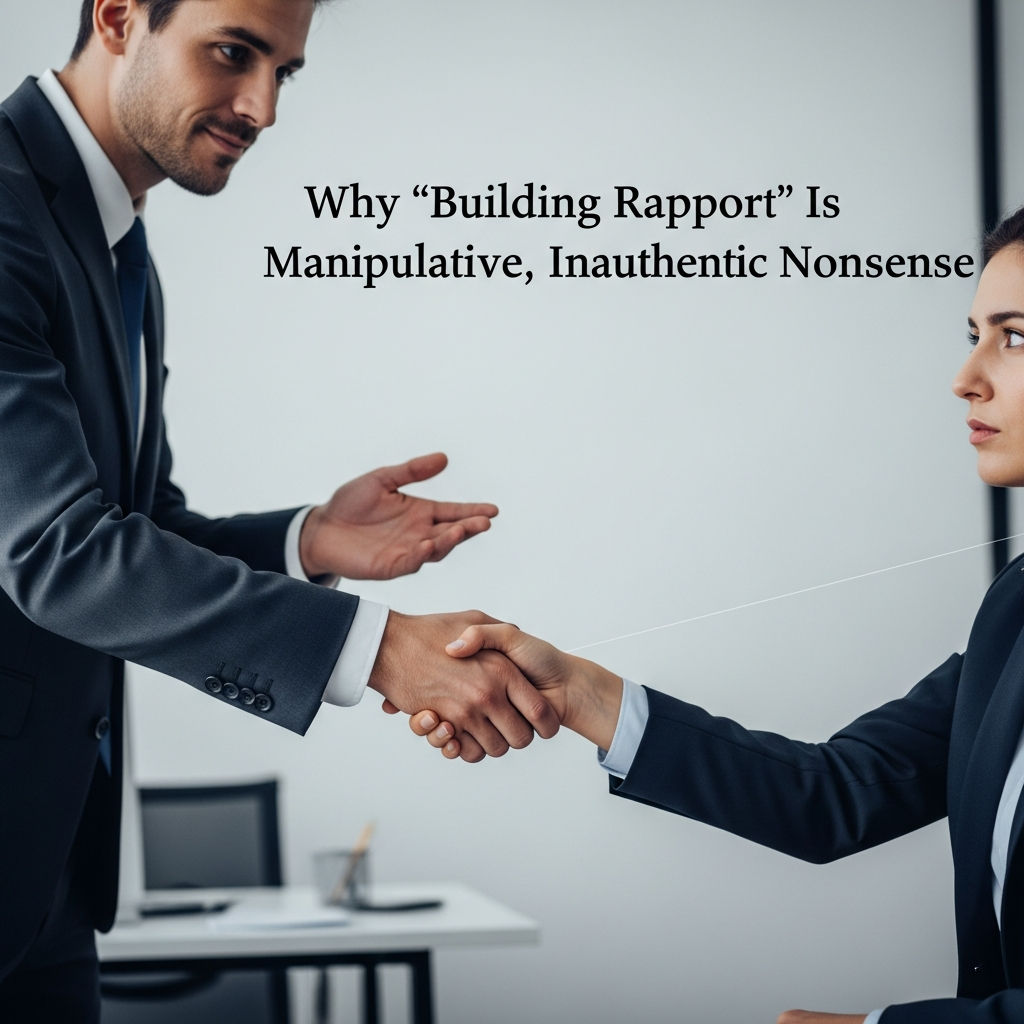
One of the most common rapport-building tips is “mirroring”—subtly mimicking the posture, gestures, and speech patterns of your interlocutor. The theory is that people like people who are like themselves. In practice, however, forced mirroring is often perceived as “uncanny” or just plain creepy. When someone leans in exactly three seconds after you do, or adopts your specific vocal cadence, your subconscious triggers a warning. Instead of feeling a connection, you feel like you are being studied by a predator or a robot.
The “Common Ground” Fallacy
We are told to scan a person’s office or social media profile to find a “hook.” If they have a photo of a dog, you suddenly become a dog person. If they mention they like hiking, you recount a story about a trail you barely remember. This search for manufactured common ground is inherently dishonest. It creates a foundation of superficiality that must be maintained throughout the entire relationship. If the relationship is built on a lie about shared interests, it lacks a stable core.
Why Building Rapport is Inherently Manipulative
At its heart, the phrase “building rapport” implies a goal-oriented process. You aren’t being friendly because you enjoy the person’s company; you are “building rapport” so that you can close a deal, win an argument, or gain a promotion. This ulterior motive transforms a social interaction into a transactional maneuver.
- Intent vs. Impact: Even if your intentions are “good,” the act of using a psychological technique to bypass someone’s natural defenses is a form of manipulation.
- The Power Imbalance: Rapport-building is often used by those in power (or those seeking it) to disarm others. It is a way of lowering someone’s guard without earning their trust through consistent behavior.
- The Inauthenticity Tax: Constantly monitoring your own behavior to ensure you are “building rapport” prevents you from being present. You are playing a character, and characters cannot form real bonds.
The Death of Authenticity in Business
Modern consumers and professionals have developed a highly sensitive “BS detector.” We live in an era of hyper-curated social media and “authentic branding” that is anything but authentic. When someone uses a scripted rapport-building opening—like asking “How are you doing today?” with that specific, practiced sales-inflection—most people immediately shut down.
Authenticity cannot be a “technique.” It is the absence of technique. By trying to “build” rapport, you are essentially admitting that a natural connection doesn’t exist, and you are trying to manufacture one to suit your agenda. People don’t want to be “handled.” They want to be seen and heard.
The Transactional Trap: Why It Backfires
When you rely on rapport-building hacks, you create a transactional atmosphere. The person you are speaking with realizes that your kindness is a tool, not a trait. This leads to several negative outcomes in the long run:
1. Fragile Trust
Trust built on rapport techniques is fragile. It is based on the “vibe” of the moment rather than the substance of your character. The moment the “performance” slips—because you’re tired, stressed, or the deal is done—the relationship collapses because there was never any real substance beneath the surface-level mirroring.
2. Reputation Damage
People talk. If you are known as the person who is “always on”—the one who uses everyone’s name five times in a sentence and always has a suspiciously perfect anecdote for every situation—you will gain a reputation for being slick but untrustworthy. In the professional world, “slick” is rarely a compliment.
3. High Mental Overhead
It is exhausting to constantly “build rapport.” Maintaining the facade of being everyone’s best friend requires immense cognitive load. This energy would be much better spent on actually solving problems, delivering value, or practicing genuine empathy.
What to Do Instead: Radical Honesty and Competence
If we throw away the “rapport-building” playbook, what are we left with? For many, the idea of entering a meeting without a script is terrifying. But the alternative is far more effective: being a real person who provides real value.
Focus on Competence Over Likability
In a professional setting, people don’t actually need to be your best friend. They need to know that you are competent, reliable, and honest. You don’t need to “mirror” a client’s body language if you have a solution that will save them $50,000. Respect is a much stronger foundation for a relationship than “likability.”
Practice Active Listening (Without the Script)
True rapport is a byproduct of listening. Instead of thinking about the next “rapport-building” question to ask, try actually hearing what the person is saying. Ask follow-up questions because you are curious, not because you are trying to keep them talking. People feel a connection when they feel understood, not when they feel mirrored.
Embrace Friction
Building rapport often involves avoiding disagreement to keep the “good vibes” going. However, healthy relationships—both personal and professional—require the ability to disagree. Radical honesty is more respectful than “polite” manipulation. If you disagree with a client or colleague, say so. That honesty builds a deeper, more resilient trust than any amount of fake common ground ever could.
Be Humanly Flawed
Perfection is intimidating and suspicious. Vulnerability, when appropriate, is the fastest way to connect with another person. Admitting you don’t know something or sharing a genuine (not calculated) struggle makes you relatable. It signals to the other person that they can also drop their guard and be themselves.
Conclusion: Toward Genuine Connection
The advice to “build rapport” is a relic of an era of sales and management that viewed people as targets to be hit. In today’s world, where everyone is selling something and everyone is skeptical, the only way to stand out is to stop the performance.
Stop mirroring. Stop searching for fake common ground. Stop using people’s names as a psychological anchor. Instead, show up as yourself. Focus on being useful, being honest, and being a human being. The rapport that follows will be genuine, lasting, and—most importantly—it won’t be nonsense.
“`